
Goals:
Deploy a robot into a hazardous area first to provide an initial visual assessment of the environment, helping reduce the risk of injury to personnel or service dogs.
Instructors:
The team consists of active-duty and reserve personnel from the Estonian Defence Forces and the Estonian Defence League, as well as rapid response officers from the Estonian Police and Border Guard Board. The instructors bring practical experience from international missions and from the ongoing war in Ukraine.
This course is designed for:
For the Estonian Police and Border Guard Board, the Estonian Internal Security Service, the Estonian Rescue Board, members of the Estonian Defence Forces and the Estonian Defence League, as well as other units operating in the security sector.
D-CQB (Drone-Close Quarters Battle)
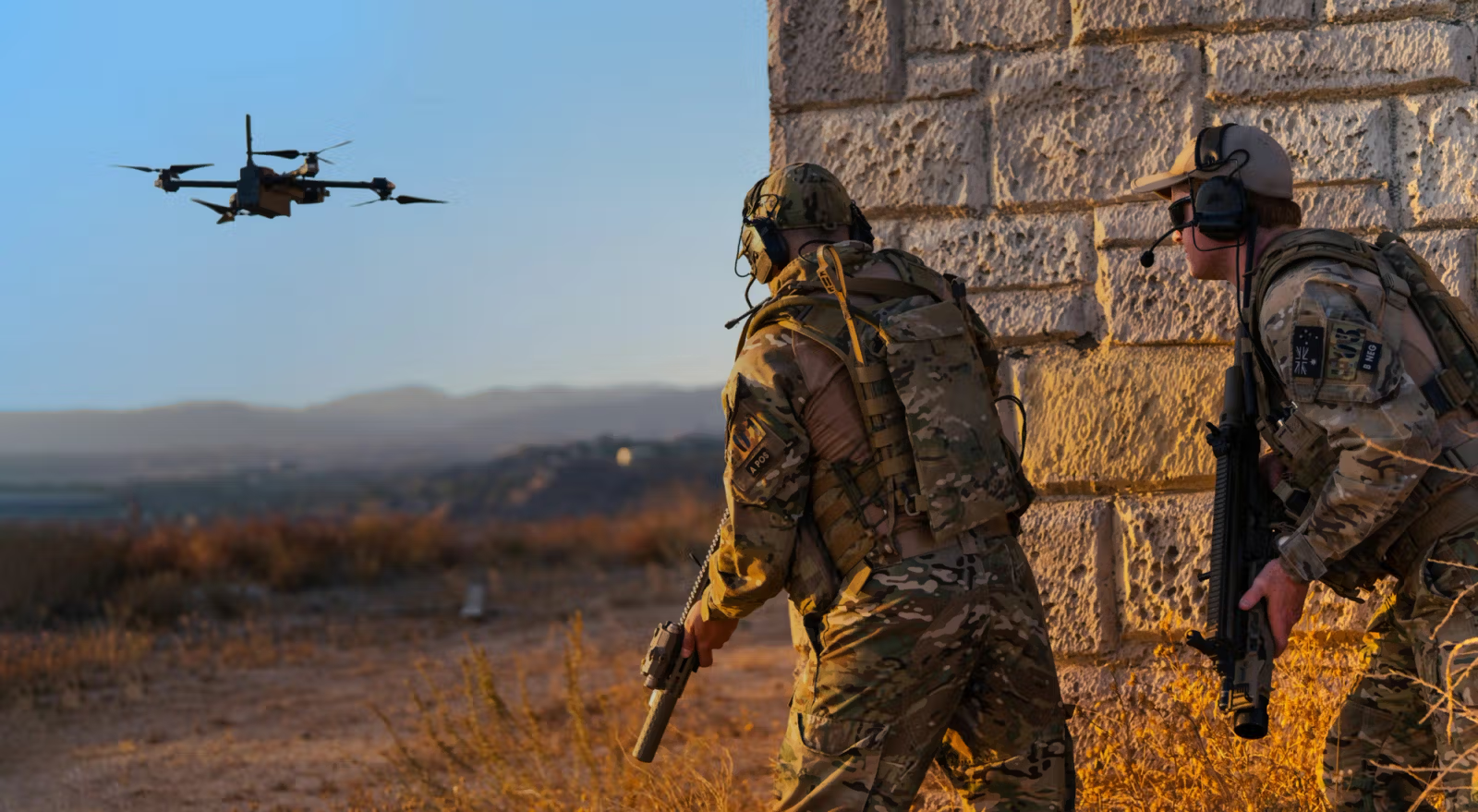
D-CQB (Drone Close Quarters Battle), or the use of drones for room-clearing operations, is an emerging concept that is gaining increasing recognition. The objective is to deploy an unmanned system into a hazardous area first, providing an initial visual assessment of the environment and helping reduce the risk of injury to personnel or service dogs. The concept is based primarily on using a cost-effective and rapidly replaceable system. In indoor environments, an unmanned aerial vehicle can serve as a force multiplier by taking on the role traditionally assigned to the pointman, illuminating dark rooms and corridors, carrying a loudspeaker for communication, transporting two-way communication devices for negotiation purposes, or carrying tear gas, flash, stun, or smoke grenades.
What makes this course distinctive is its emphasis on highly realistic locations and scenarios rather than relying solely on enclosed and uniform training facilities that lack realistic furnishings and environmental conditions. Training environments may include schools, shopping centres, urban warfare training areas, apartment buildings, industrial facilities, ports, and other locations that could realistically represent potential incident sites.
The instructor team consists of active-duty and reserve personnel from the Estonian Defence Forces and the Estonian Defence League, as well as rapid response officers from the Estonian Police and Border Guard Board. The instructors bring practical experience from international missions and from the ongoing war in Ukraine.
The course is intended for the Estonian Police and Border Guard Board, the Estonian Internal Security Service, the Estonian Rescue Board, members of the Estonian Defence Forces and the Estonian Defence League, as well as other units operating in the security sector.
Courses are conducted in Estonia. The exact training location is provided prior to the start of the course. If required, the training can also be delivered in another country and environment suitable to the client’s operational needs.
D-CQB01 – Basic UAV operator skills (3 days)
Experience: No previous drone flying experience is required.
Equipment: Comfortable workwear suitable for practical training.
Group Size: 8–12 participants.
Skills Acquired: Participants will gain a fundamental understanding of different types of indoor drones, their operational use cases, and relevant modifications that can improve mission effectiveness. The practical exercises are designed to help even participants with no previous drone experience develop the necessary basic flight skills. At the same time, trainees will complete scenario-based tasks that prepare operators for situations they may encounter in real-world operations.
D-CQB01.5 – Basic UAV operator skills combined with K9 (3 days)
Experience: No previous drone flying experience is required.
Equipment: Comfortable workwear suitable for practical training. A K9 team must be provided by the client.
Group Size: 8–12 participants.
Skills Acquired: Participants will gain a fundamental understanding of different types of indoor drones, their operational use cases, and relevant modifications that can improve mission effectiveness. The practical exercises are designed to enable even participants with no previous drone experience to develop basic flight skills. At the same time, trainees will complete scenario-based exercises that prepare operators for real-world operational situations. The primary objective is to train K9 teams, dog handlers, and drone operators to work effectively together as an integrated team.
D-CQB02 – Advanced UAV operator skills with C-UAS elements (3 days)
Experience: Previous drone flying experience is required. A background in CQB is mandatory.
Equipment: Comfortable operational gear is required, including plate carriers, duty belts, weapons, and other relevant equipment.
Group Size: 8–12 participants.
Skills Acquired: The objective is to build on the skills developed in the D-CQB01 module, with a stronger focus on team drills and the integration of additional specialists such as snipers, breachers, and other supporting roles. During the course, participants work through practical tasks and scenarios designed to prepare operators for situations they may encounter in real-world operations. Participants will gain more advanced knowledge of using unmanned aircraft during entry and room-clearing operations. The course is conducted in urban environments and is not limited to indoor training areas.
D-CQB03 – Advanced UAV operator skills with FPV and C-UAS elements (4 days)
Experience: Completion of the D-CQB02 module is required. Previous FPV flying experience is mandatory.
Equipment: Comfortable operational workwear.
Group Size: 8–12 participants.
Skills Acquired: Participants will gain a fundamental understanding of FPV drones, their operational use cases, and relevant modifications that can improve mission effectiveness. The practical exercises are based on real-world scenarios. The use of FPV drones further expands operational options for threat mitigation due to their open and adaptable platform architecture.
The course also introduces elements of electronic warfare that may affect flight operations, including signal jamming, spoofing, and kinetic countermeasures. Training is conducted in urban environments and is not limited to indoor scenarios.
Looking for Expert Guidance?
Meridein Grupp OÜ provides both paid and complimentary consultancy services for public-sector officials, organizations, and other professionals interested in the sector. Our services include comprehensive product introductions, expert guidance, and practical support.
We provide detailed information on product software, technical capabilities, and system functionality. Where required, we can also obtain relevant compliance certificates and technical documentation directly from the manufacturer.
We provide detailed information on product software, technical capabilities, and system functionality. Where required, we can also obtain relevant compliance certificates and technical documentation directly from the manufacturer.